
Commercial Lift Station Guide for Property Managers
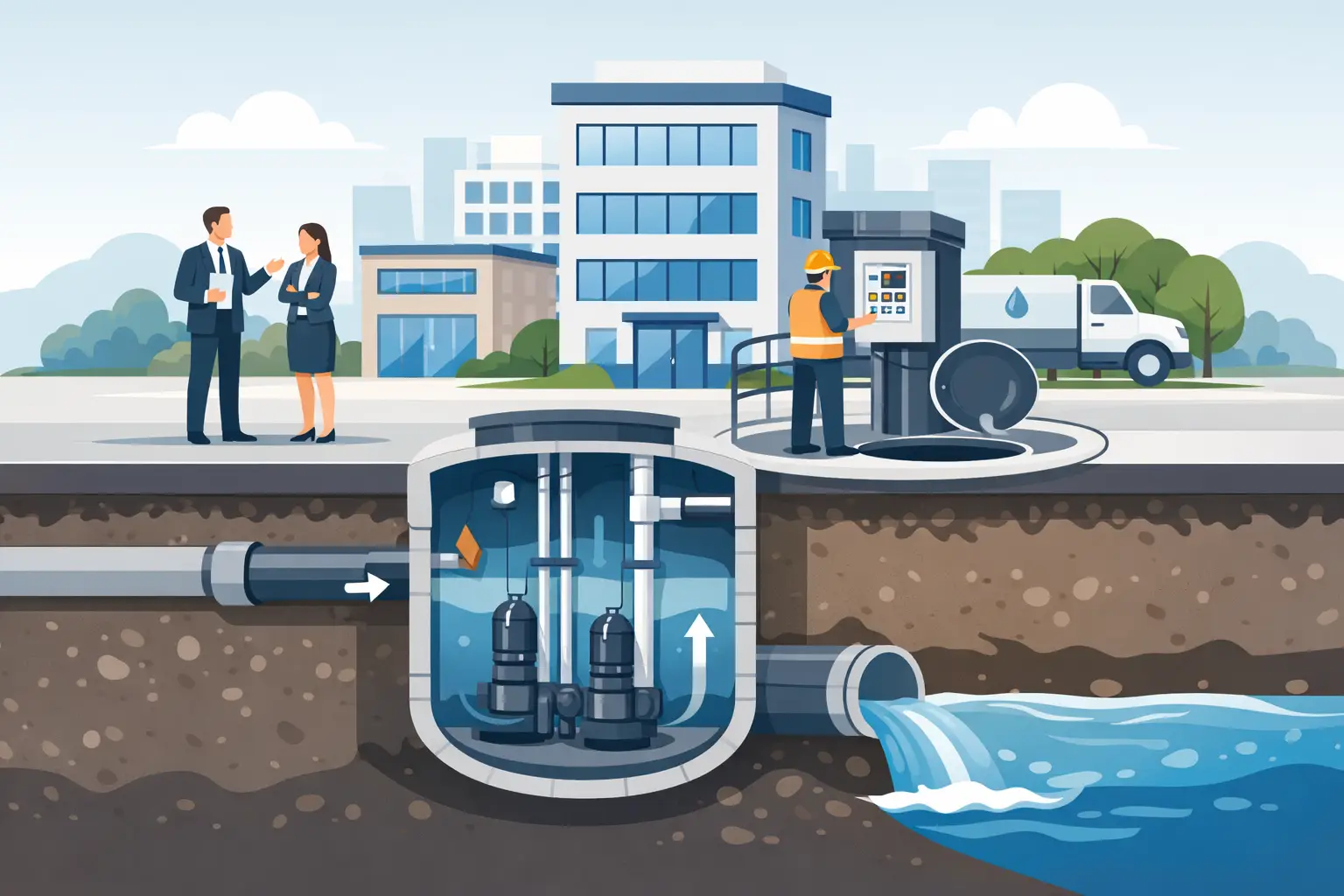
A commercial lift station is easy to overlook when it is working. When it fails, wastewater can back up into restrooms, kitchens, tenant spaces, or exterior areas within hours. This commercial lift station guide explains what property managers need to know about operation, warning signs, maintenance, and the decisions that protect a facility from costly downtime.
A lift station is not a standard plumbing fixture. It is a wastewater collection and pumping system that requires mechanical, electrical, and control expertise. Treating it as a basic plumbing issue can delay the right repair and make a manageable problem much worse.
What a Commercial Lift Station Does
A commercial lift station moves wastewater from a lower elevation to a higher point where gravity flow can continue. It is common at properties where the building sewer sits below the municipal connection, septic tank, treatment system, or drain field. Restaurants, retail centers, offices, campgrounds, multifamily buildings, warehouses, and rural commercial sites may all rely on one.
Wastewater enters a wet well or basin. As the level rises, floats or level sensors signal a control panel to start one or more pumps. The pumps push wastewater through a force main to the next part of the system. When the level drops, the controls shut the pump off.
That process sounds simple, but several components have to work together: pumps, float switches or sensors, check valves, isolation valves, electrical connections, breakers, alarms, control panels, and the discharge line. A failure in any one of them can trigger an alarm, create a backup, or leave a pump running when it should be off.
The Warning Signs That Need Fast Attention
A high-water alarm is the clearest sign that the lift station needs attention. Do not silence it and assume the issue is resolved. The alarm indicates that the wastewater level has reached a point above normal operating range. The pump may be unable to keep up, may not be starting, or may be running without moving wastewater.
Other warning signs can be less obvious. Slow drains throughout the building, gurgling fixtures, sewage odors near the station, wet ground around the basin, repeated breaker trips, or an unusually loud pump can all point to a problem. In a duplex or larger facility, occupants may first report backup in the lowest-level restroom or floor drain.
A commercial site should also take notice when its electric bill rises without another clear explanation. A pump that runs continuously because of a failed float, a clogged discharge line, or a damaged check valve can consume significant power before it fails completely.
If wastewater is backing up, stop unnecessary water use immediately. Restrict restroom use, dishwashing, laundry, and any process that sends water to the system. Continued flow can overwhelm the remaining storage capacity in the wet well and turn an equipment repair into a cleanup, health, and operational emergency.
The Most Common Commercial Lift Station Failures
Pump failure is common, but it is not the only cause of a lift station emergency. Pumps can clog with wipes, rags, hygiene products, grease, or debris. They can also wear out from age, heavy use, corrosion, or operation outside their intended capacity. A pump that hums but does not move water may have a jammed impeller, mechanical failure, or electrical issue.
Float switches are another frequent problem. Floats can become tangled, coated with grease, obstructed by debris, or damaged by repeated movement. If the lead float fails, the pump may not start. If the stop float fails, the pump may run too long. If the high-level alarm float fails, the property loses a critical early warning.
Control panels require equal attention. A tripped breaker, failed relay, damaged contactor, loose wire, corroded connection, or incorrect settings can prevent the pump from operating correctly. In duplex stations, the alternating controls that share run time between two pumps can also malfunction, leaving one pump to carry the entire load.
The discharge side matters as much as the pump. A failing check valve can allow wastewater to fall back into the basin after each cycle. The pump then has to move the same volume again and may short-cycle. A partially blocked force main can reduce flow until the station cannot keep up during busy periods. These conditions are not always visible from the surface, which is why proper diagnosis matters.
Commercial Lift Station Maintenance That Prevents Emergencies
Maintenance intervals depend on wastewater volume, pump design, site use, basin size, and the consequences of downtime. A small office with predictable use has different needs than a restaurant, apartment complex, event venue, or commercial kitchen. There is no responsible one-size-fits-all schedule.
Still, routine service should include a functional test of pumps, floats, alarms, and controls. The basin should be inspected for grease buildup, debris, and signs of abnormal cycling. A technician should check amperage draw, verify that the pump is moving water, inspect electrical connections, and confirm that check valves and isolation valves are operating as intended.
For stations with two pumps, each pump should be tested independently. The system should alternate lead pump duty where designed to do so, and both pumps should be capable of operating when demand is high. A second pump that has not run in months is not a backup plan. It is an unverified risk.
Documented maintenance is especially valuable for commercial property operators. Service records show recurring issues, establish equipment history, support budgeting decisions, and help demonstrate reasonable care after an incident. They are also useful during property sales, insurance reviews, tenant disputes, and compliance-related inspections.
Choosing Repair, Upgrade, or Replacement
The right decision depends on the actual failure, the station’s age, its design capacity, and the property’s future use. Replacing a failed float or relay may be the practical repair for an otherwise sound station. Replacing a worn pump can restore reliable service when the basin, controls, and discharge line are in good condition.
Replacement or redesign becomes more reasonable when failures repeat, pumps are undersized, the station has no alarm protection, or the property use has changed. A restaurant added to a retail center, a building conversion, an expanded occupancy load, or new water-using equipment can push an older lift station beyond its original design.
Control panel upgrades can also make a major difference. A properly configured panel with audible and visual alarms, pump alternation, hand-off-auto controls, and remote monitoring options gives managers earlier notice of trouble. Remote monitoring is not necessary at every site, but it can be worth the investment where a backup would close operations, damage inventory, or create major tenant disruption.
Do not select a pump based only on horsepower or the lowest replacement price. Pump selection must account for required flow, total dynamic head, solids handling needs, force-main conditions, and actual wastewater characteristics. An incorrect pump may run, but it may not solve the operating problem.
What to Do When the Alarm Sounds
Start by limiting water use and keeping people away from any sewage-affected area. Check whether the control panel has power, but do not open electrical equipment or enter the wet well. Lift station basins can contain hazardous gases and are confined spaces. Entry requires trained personnel, proper equipment, and a safe confined-space procedure.
Record what you see before the situation changes: alarm status, panel lights, unusual sounds, recent power interruptions, weather events, drain complaints, and changes in building use. This information helps a wastewater specialist diagnose the failure faster.
Then arrange service from a contractor experienced with commercial wastewater systems. The response may require pump repair, control troubleshooting, float replacement, basin cleaning, valve service, force-main investigation, or a full system assessment. The key is identifying why the station failed, not simply resetting the alarm and leaving.
A commercial lift station protects the entire property when it is maintained and monitored correctly. If an alarm is active, fixtures are backing up, or the station is cycling abnormally, act before the wet well reaches its limit. Aquamatic can assess the equipment, identify the cause, and put the right repair or upgrade plan in place.